
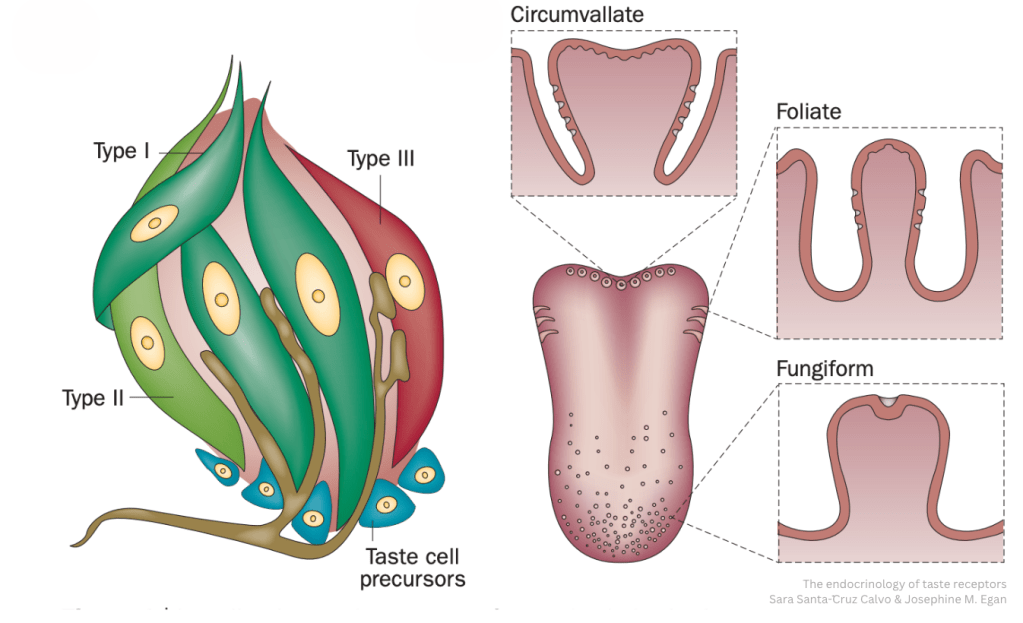
Aristotle (384–322 BCE) argued that taste was carried from the tongue to the heart, which is still believed in some parts of India hyperbolically. You would be amazed to know taste buds begin forming around the 6th week of embryonic development and continue to significantly influence our food choices until we take off. So, it would be good to know how they do that.
Let’s take it from the tip.
Your tongue is covered with tiny bumps called papillae, and inside these bumps are even tinier clusters called taste buds. And each taste bud has a set of specialised cells that can detect different flavours like sweet, salty, sour, bitter, and umami (which is a savoury taste, like in cheese or soy sauce). Interestingly, we have around 10,000 taste buds, but this number varies from person to person, and for the same reason, we have a profession of wine tasting. Some of them are “super tasters” and can detect flavours more intensely because they have more taste buds!
Now, here are the four sets of cells in taste buds.
Think of type I cells as the support crew. They help keep everything clean by clearing extra chemicals after sending a taste signal. Then there are type II cells, which are like the specialized detectives in charge of detecting sweet, bitter, and umami (savoury) tastes. Type III cells are the experts in detecting sour taste, which comes from acids, like the citric acid in lemons, releasing hydrogen ions. Lastly comes our backup team, type IV cells. They don’t detect tastes but are the cells that grow into new type I, II, or III cells when the old ones wear out.
And why would old ones wear out? Well, because taste bud cells only live for about 8-22 days. Why else would you think your tongue healed so fast after sipping a hot cup of coffee?
In terms of nerves related to taste, there are three primary nerves involved. First is the facial nerve, responsible for taste at the front of the tongue. Second, there’s the glossopharyngeal nerve, which is involved in taste at the back of the tongue. Lastly, the vagus nerve plays a role in the taste sensation in the throat.
So next time you take a bite, remember, first, your taste buds will detect the flavours and send the information to the brain, which will then combine this information with other senses, like smell and texture, to give you the full experience of eating. And coming back again if you like it enough.
P.S. Umami taste comes from amino acids (the building blocks of proteins), which signals that the food is rich in protein and is essential for muscles and overall health.
References:
1. https://link.springer.com/article/10.1007/s00424-020-02464-4
2.https://www.sciencedirect.com/science/article/abs/pii/B9780444638557000101?via%3Dihub
3. https://www.nature.com/articles/nrendo.2015.7
4. https://wires.onlinelibrary.wiley.com/doi/10.1002/wsbm.1547
 grewal